
The End Of The League
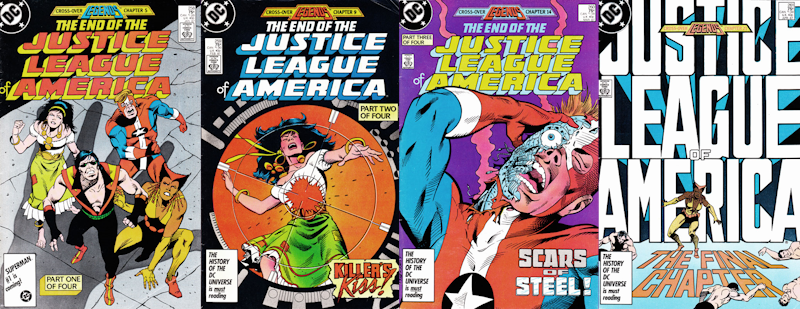
JUSTICE LEAGUE OF AMERICA #258 – 261
Written by J.M. DeMatteis with art by Luke McDonnell, Bob Smith, Bill Wray, Steve Montano and Bob Lewis.
So here we are, at the end of my look back over the JUSTICE LEAGUE OF AMERICA title from 1985 to 1987 and at the end of the Justice League Detroit era. This post is a bit picture heavy but I wanted to capture as much of it as I could.
Before we plunge headlong into The End of The Justice League of America a little bit of background to the events of these issues.
The previous story arc ended with Firestorm asking the League for help against a bad guy called Brimstone. This huge fire demon was sent to Earth by Darkseid as part of his plan to discredit the very concept of heroes and was his first wave of attack, along with Glorious Godfrey and Dr Bedlam. All of this was part of that year’s summer event called LEGENDS which was a sort-of sequel to CRISIS ON INFINITE EARTHS but didn’t have the same scope and, to be honest, suffered from a frankly saccharine ending. Not John Ostrander’s finest moment by a long stretch, though the art by John Byrne and Karl Kesel is excellent.
Anyhow, the League agree to help Firestorm and with him and some help from a time-lost Cosmic Boy, they attack Brimstone in LEGENDS #2 and are almost instantly defeated.
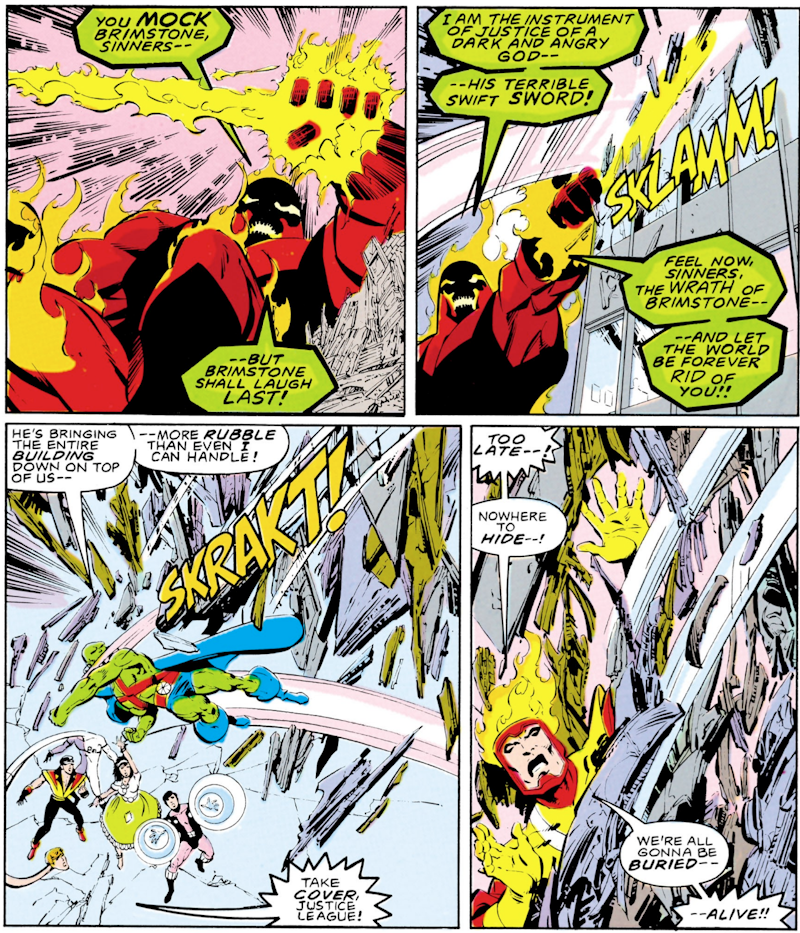
By the end of LEGENDS #2, President Ronald Reagan issues an order banning costumed heroes from appearing on the streets. It’s after this that we pick up with JUSTICE LEAGUE OF AMERICA #258 . . . but what we start with is the screaming, mutated face of Professor Ivo who sits with his psychiatrist, blaming the heroes of the Justice League for turning him into a monster. He claims the League was jealous of his success in attaining immortality and punished him by disfiguring him. The psychiatrist, however, tells him the truth about his immortality serum’s unstable nature which caused his condition, but the truth isn’t received well at all.
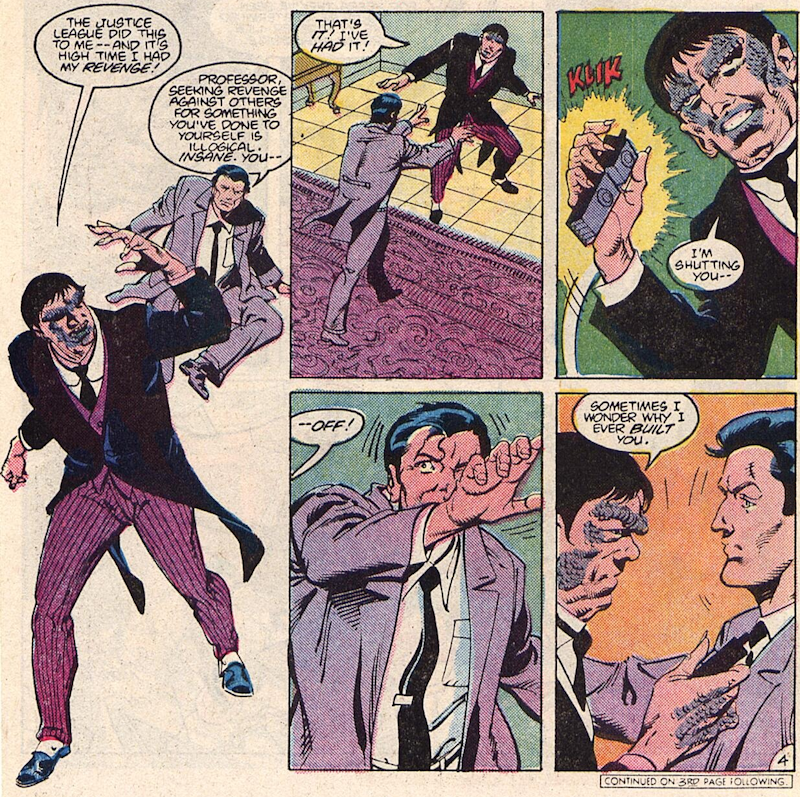
And so it becomes clear that Ivo, creator of Amazo, has built his own android psychiatrist.
Back at League HQ, Vibe berates his fellow heroes and himself, bemoaning their defeat at Brimstone’s hands and running down the name of the League itself so much so that Elongated Man lashes out and attacks him.
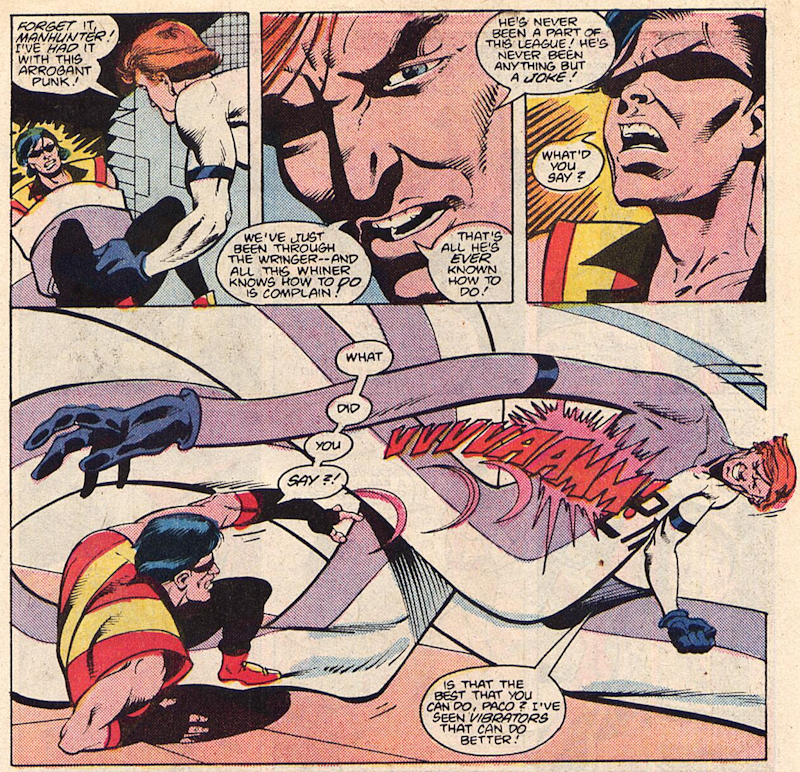
It takes J’onn J’onzz to separate the pair of them which in turn leads to him making a hard decision:
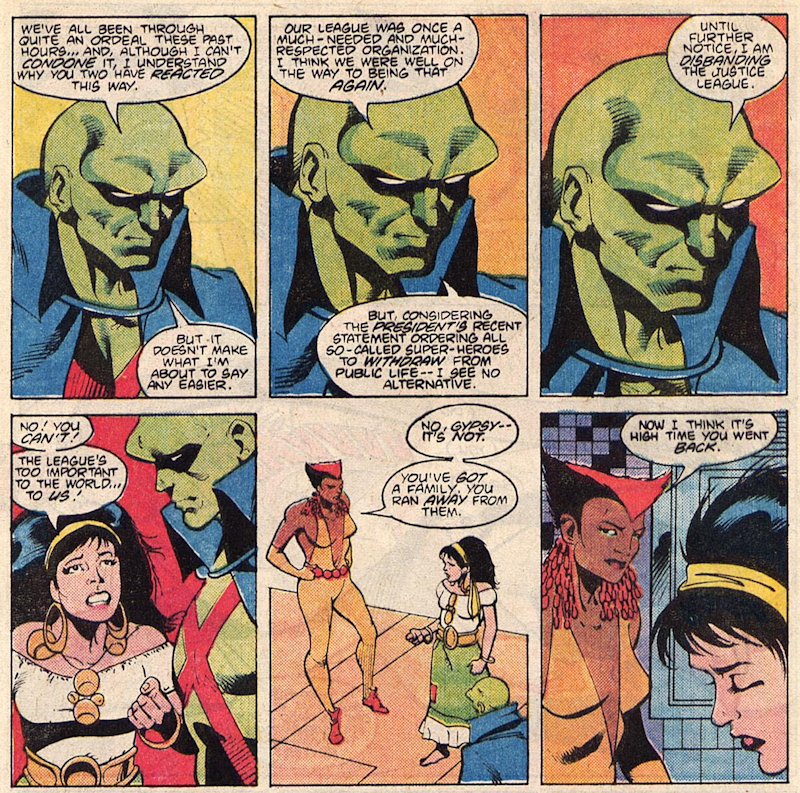
He disbands the League citing the Presidential order as the main reason as well as delivering a nice compliment to the young heroes and, at the same time, to Gerry Conway’s ideas about the team. Elongated Man leaves and, convinced that J’onn is disbanding the League simply to jettison himself and the others, Vibe lashes out at him. Within moments, the League is no more.
The insane Professor Ivo releases another of his androids, this one sent to target Vibe who we catch up with in the South Bronx where he meets a street kid who’s drawn a picture of Superman. Already disheartened by the League’s break-up, poor old Vibe gets a harsh lesson in marketing:
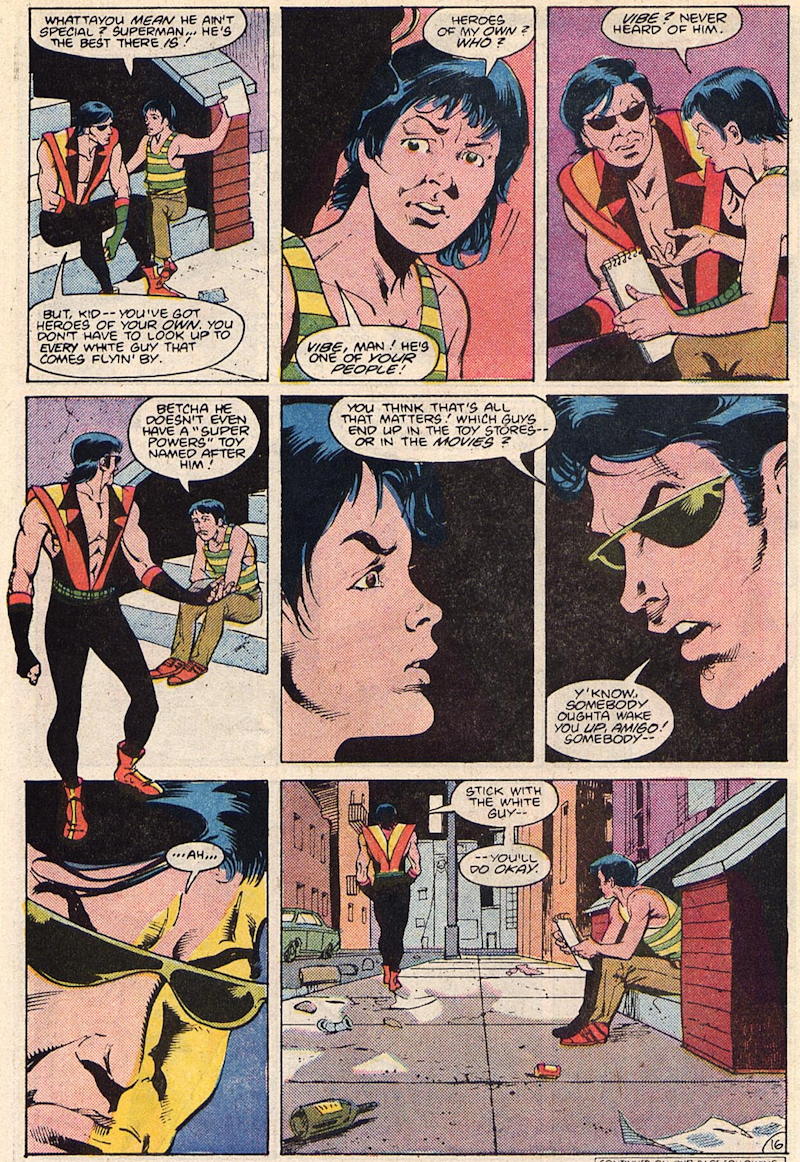
Walking away, he literally bumps into Ivo’s android who attacks him as the kid watches. Discovering his attacker is an android, Vibe has a moment of doubt, thinking of himself as a joke, but soon rallies and manages to take his assailant down.
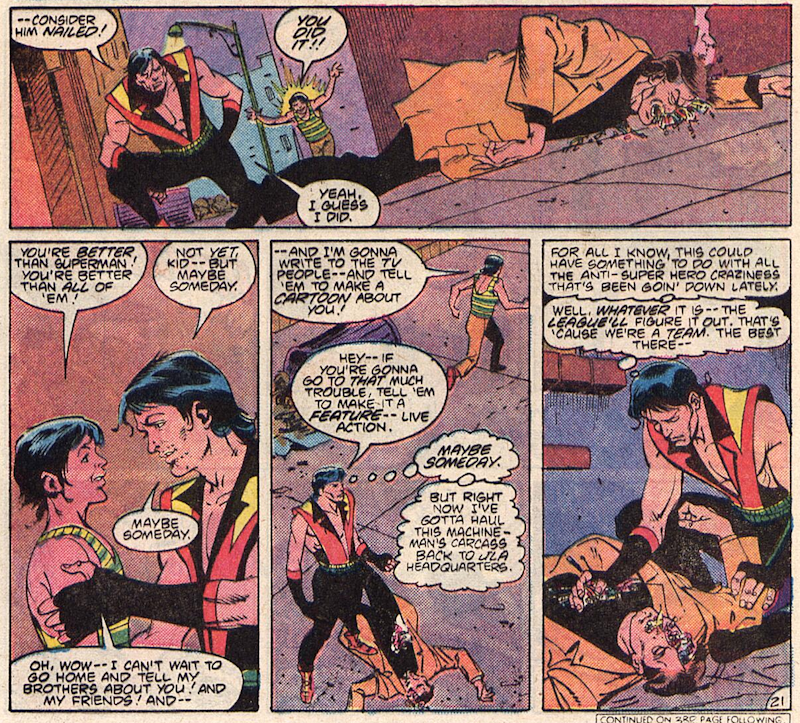
While the street kid runs off, full of enthusiasm for his new hero, the seemingly inert android has one more trick up its sleeves:
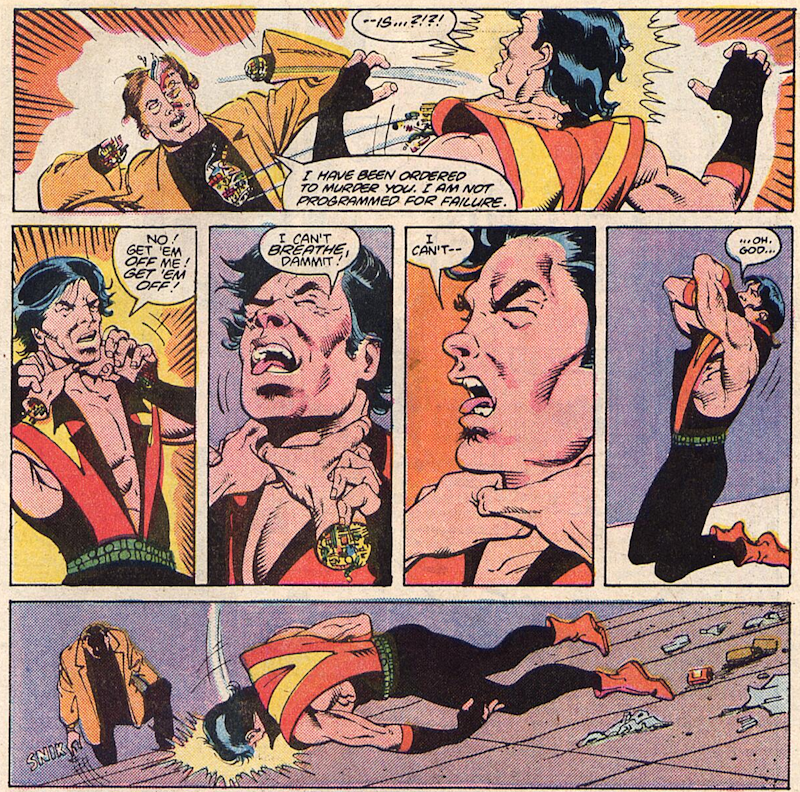
And just like that, Vibe, the break-dancing, gang-running punk from Detroit who became a member of the World’s Greatest Super-Heroes . . . dies.
In issue #259 J’onn, Vixen and Steel turn up to find the poor guy laying where the android had left him, a thin mask of Professor Ivo’s face left on top of Vibe’s own. If there was any doubt at the end of the fight, it’s put aside by J’onn:
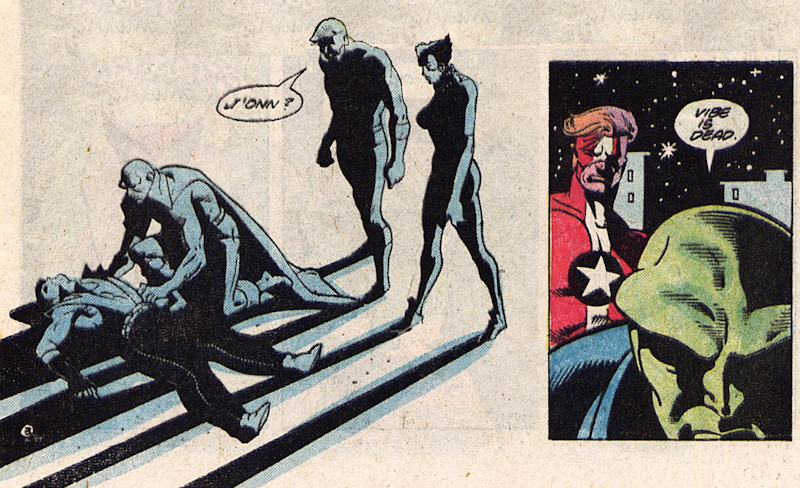
As J’onn recognises the mask, police arrive and attempt to take control of the situation which, through a combination of grief and the cops’ fear of the costumed heroes, descends into Steel impotently smashing their car.
Ivo, meanwhile, sits himself down with a new android psychiatrist and confesses that while he wants to kill the heroes for what they’ve done to him, when it comes to Gypsy . . .
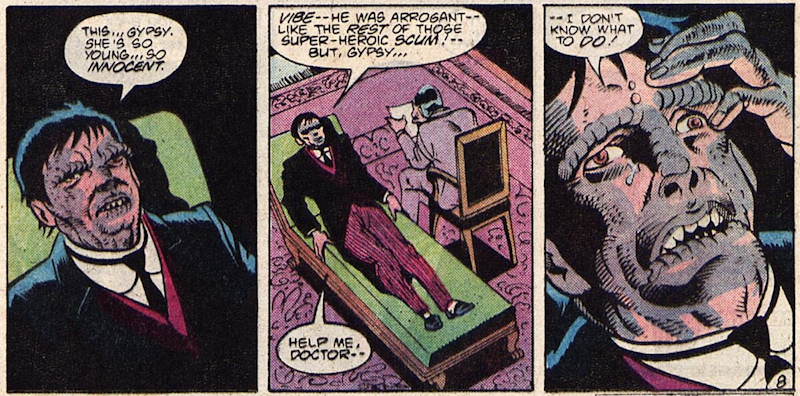
. . . he has doubts. Sadly, not enough to prevent him sending yet another assassin out to kill Gypsy.
She, meanwhile, has helped her friend Pamela to return to her home, taking it as a sign that, with the end of the League, she should do the same and go home herself. She accepts a ride from a passing car which turns out to be driven by the android assassin who attacks her, chasing her into some nearby woods. Back in his hideout, Ivo watches the scene unfold after a brief burst of interference:
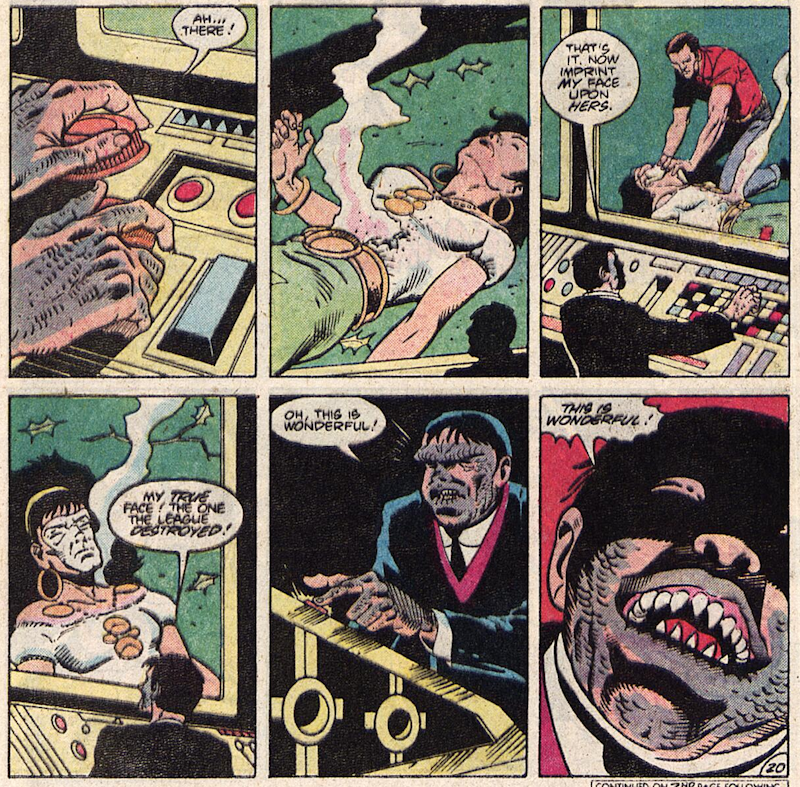
but within seconds, he is overcome with remorse for Gypsy’s death.
It turns out, though, that because the android was made in Ivo’s image, it inherited the Professor’s doubts about killing Gypsy and with her projecting an illusion of her death through his sensors, they were able to fool Ivo. The android drives her home where Gypsy is reunited with her family while outside, J’onn arrives and confronts the android.
Issue #260 picks up with J’onn and the android getting into a fight – while the android may have had Ivo’s reticence about Gypsy, J’onn doesn’t get that benefit, forcing him to take drastic measures:
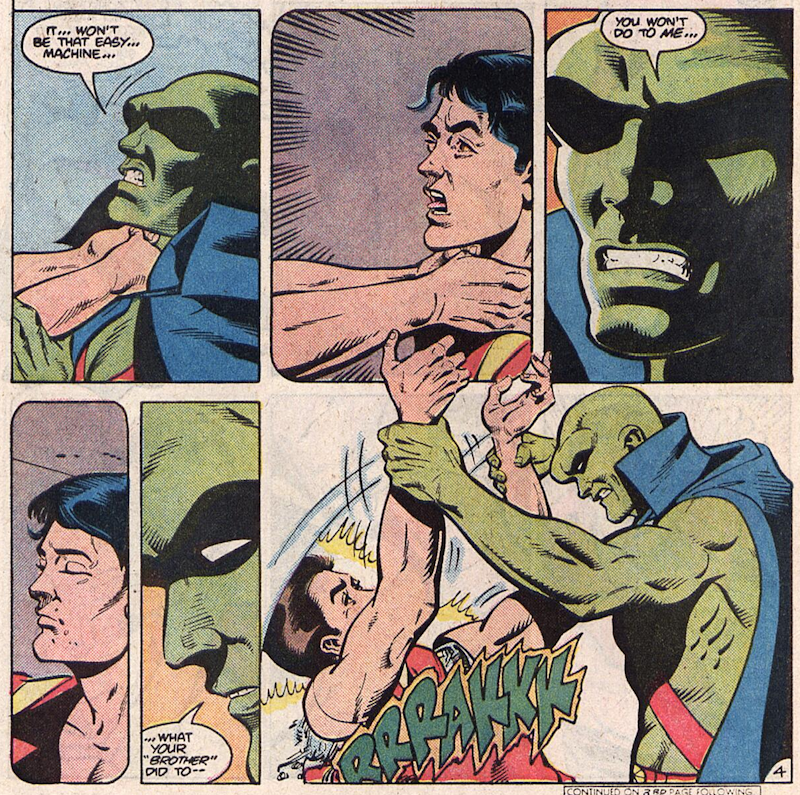
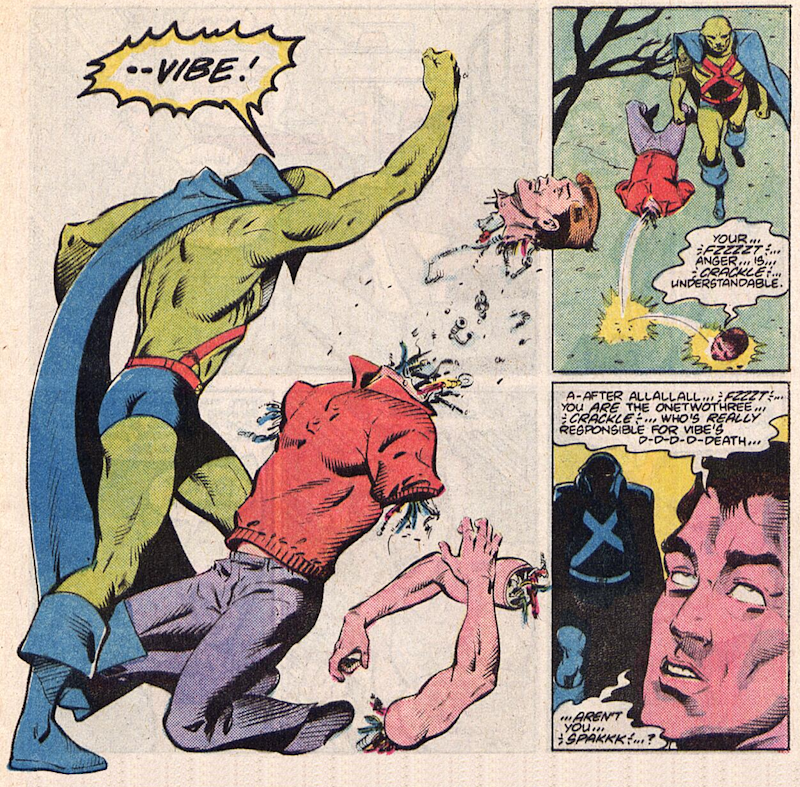
At Vixen’s apartment, she and Steel argue when he decides to ignore the Presidential order and to go out on the street once more. Meanwhile, Ivo’s having yet another session with his self-made psychiatrist but, for the first time, we get a glimpse of a man in a padded cell:
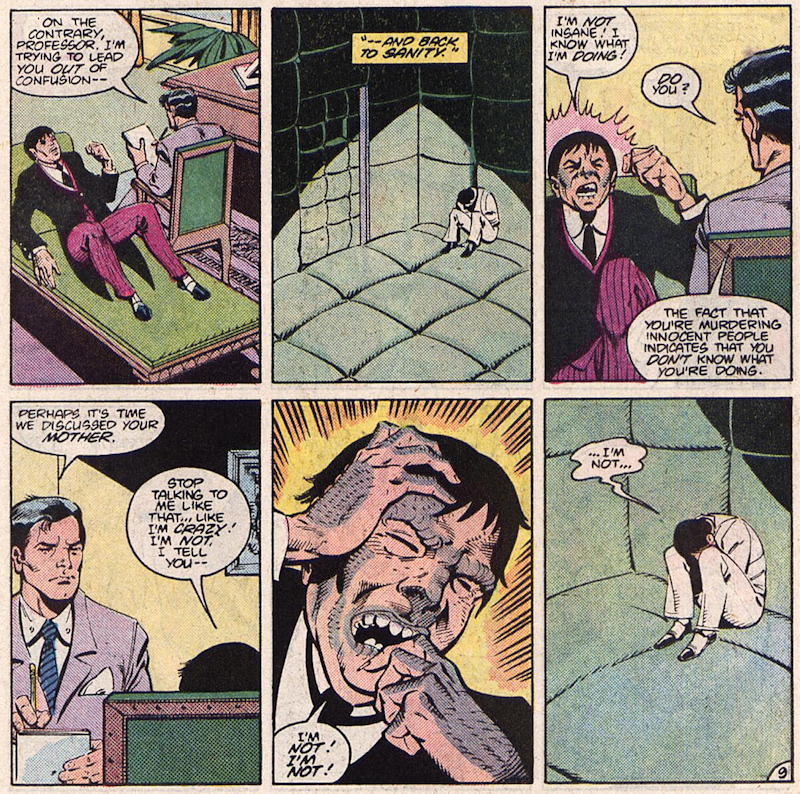
Parading the streets in costume, Steel hopes to draw out another of Ivo’s androids and, as the police are called on him by a worried public, he finds one of them masquerading as one of the cops:
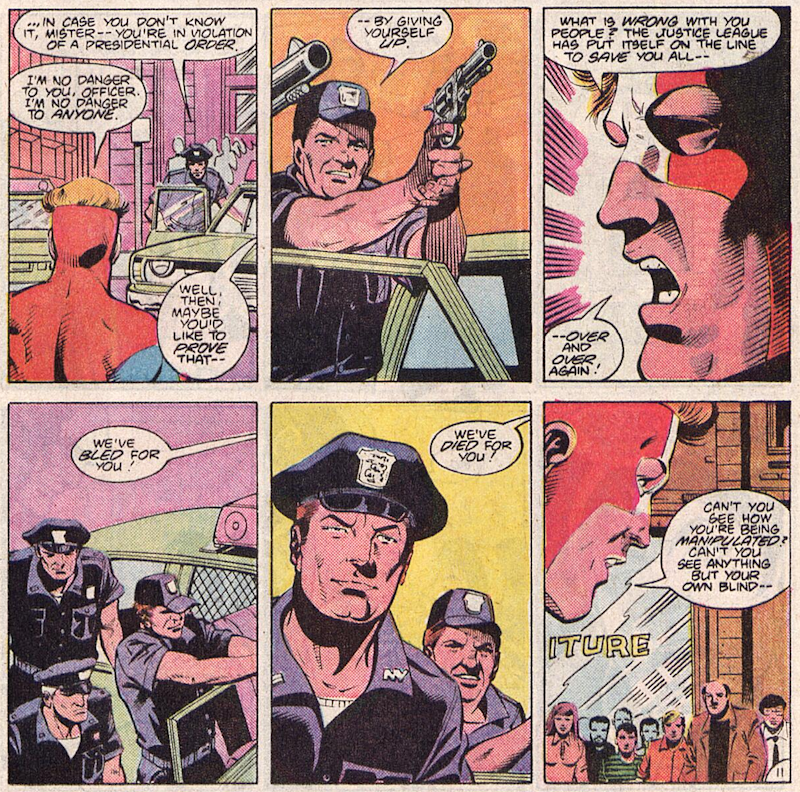
While Vixen, spurred on by Steel, decides to go hunting for Ivo himself, Steel confronts the android cop, inadvertently spurring the public on in their Glorious Godfrey-inspired hate for heroes. Attempting to avoid getting them involved, Steel drags the cop into an alley to question him but, unfortunately, things don’t go well for Steel and he staggers back out . . .

Valiantly, Steel battles through the pain of his injuries, forcing the android to expend all of its power, pushing it to a critical mass before it explodes. Steel, hero to the end, contains the blast with his body, saving the other cops before J’onn arrives.
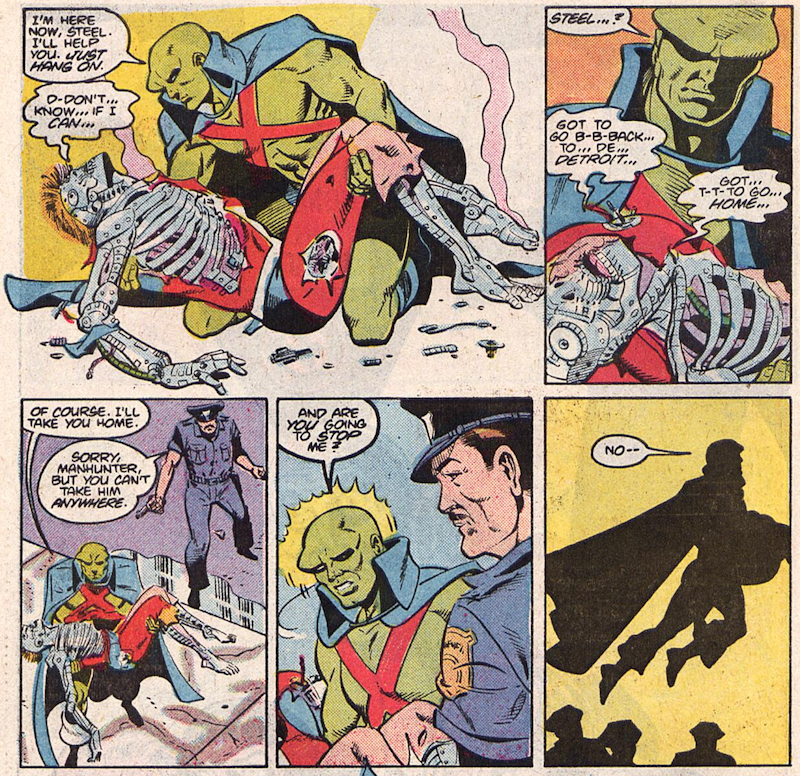
J’onn takes him back to Detroit, the bunker and his grandfather, Commander Steel. Realising there is nothing he can do to save his grandson, Commander Steel switches off his life support system and Steel dies.
The final issue begins with the man in the padded cell and straightjacket, remembering what has gone before while denying any responsibility, thus sounding like Professor Ivo. But at the same time, Ivo is being treated by another of his psychiatrist androids, one which he destroys in a fit of pique.
Vixen, meanwhile, continues using her animal powers to track Ivo, fending off random street bums to track her prey down, into the sewer where she finds his hideout. Her attack on the Professor is halted by the arrival of a dozen of his androids which, initially, don’t stand a chance against her:
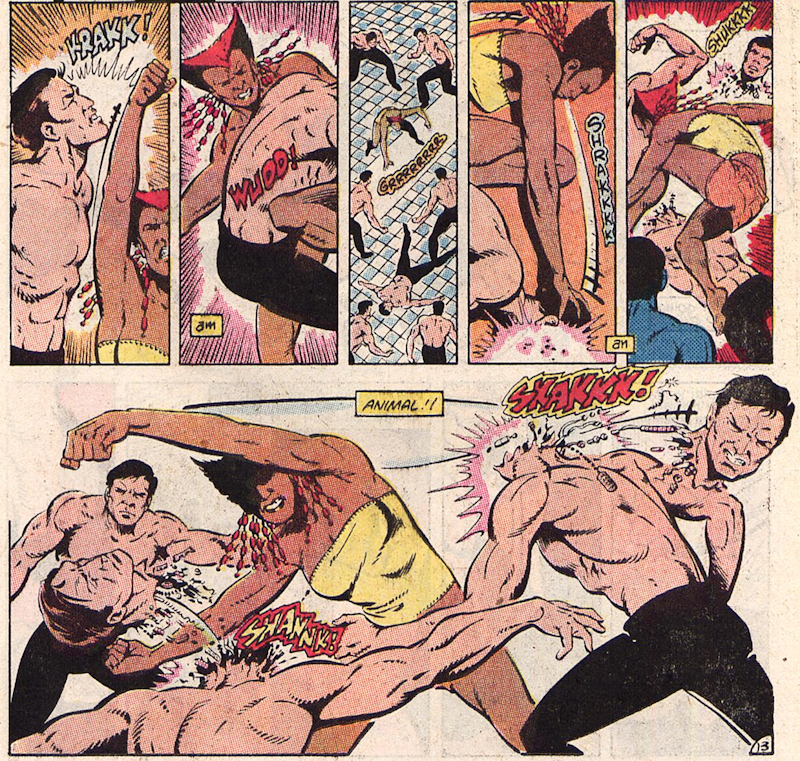
All too soon, she is overcome by their numbers but is saved at the last minute by the arrival of J’onn. Together they manage to disable the androids, turning to the Professor, and while J’onn can’t bring himself to beat on the pathetic man, Vixen has no such qualms.
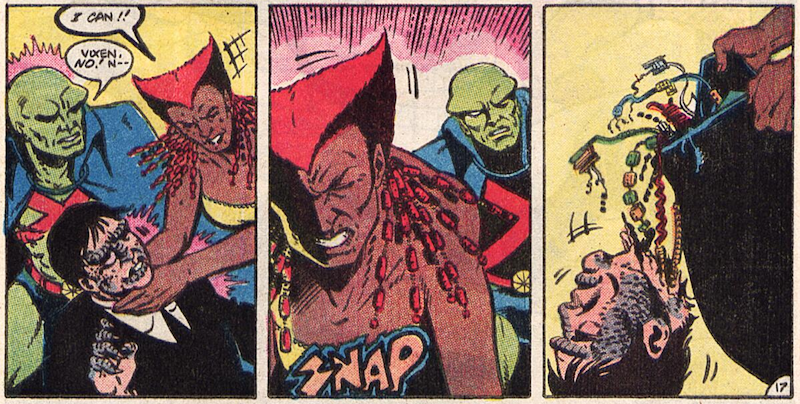
The Professor we’ve been reading about all along, turns out to be yet another android. The man in the padded cell is the real Ivo:
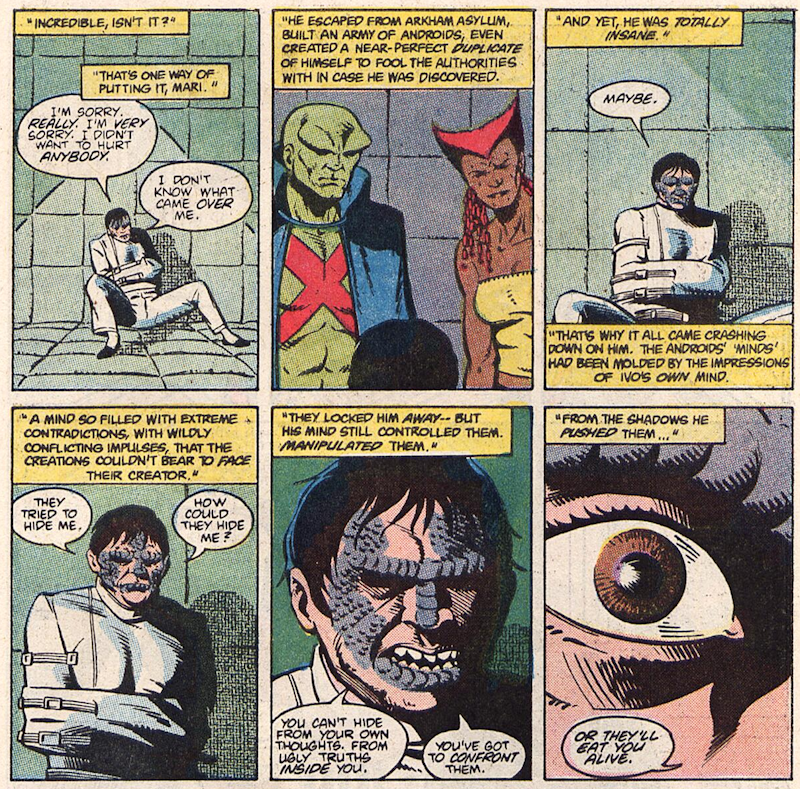
With Ivo finally captured, J’onn and Vixen return to the League HQ and while the Martian determines to carry on with the League, even in the face of the Presidential order, Vixen bows out:

And with that, the Justice League of America ends.
The deaths of Vibe and Steel, along with the resignations of Gypsy and Vixen, brought an end to the experiment that was Justice League Detroit. Did it work? As a version of the League, it would appear not: their introduction and first story arc were both weak, primarily because of the lack of any threat. While the old League handed over to them it took their first real challenge for them to show any promise and by that time they’d had an annual and eight issues. They played no real part in the CRISIS, DC’s biggest event ever, and then spent far too much time worrying about apartments and jobs.
Bogged down by sub-plots that dragged on for months, it wasn’t until the rejuvenated Despero’s appearance that the team actually faced a threat worthy of the League, but by then it was too late. Conway was off the book, LEGENDS rolled around and DC demanded that the team be completely reformed.
On the whole, the stories were slow and uninteresting. Had there been more action to distract readers from the new characters (particularly Vibe and Gypsy who came in for a lot of hate mail) those new heroes may have had a chance to grow. As it was, Vibe was never anything more than a street punk with a chip on his shoulder; Gypsy little more than a runaway.
And yet . . . I’m still fond of this League. Nostalgia plays a part in that, along with a sort of thankfulness – had this League worked, we may not have had the Giffen/DeMatteis version that grew from LEGENDS. That both Vixen and Gypsy went on to join other versions of the League down the years goes some way, I think, to showing that they were viable characters worthy of a second look.
Of course, we never had the chance to find that out about Vibe and Steel; for them it really was the end.
Or was it?

 Crisis on Earth-Prime