Random Retrospective #35 – Fatale #12

FATALE was one of those comics I picked up based on a few pages of previews, probably in PREVIEWS magazine. I knew the name of Ed Brubaker, and I’d seen Sean Phillips’ art before – I think his run on HELLBLAZER years before was the first time I’d seen his stuff – but despite their long working relationship, I’d never picked up anything by the pair. I like a bit of noir fiction now and then, especially if it’s mixed in with some horrific, Lovecraftian overtones, so FATALE seemed like it would be worth a punt.

And it was.

This issue was a stand alone, one and done flash-back that explored the past of the main character Josephine who may or may not be the same woman as Mathilde here in 13th century France – you’ll have to forgive my ageing memory. Mathilde is believed to be a witch and is captured and burnt at the stake by the local religious order.

However, she survives the flames and wakens to find the monks killing each other, driven mad by their desire for her – that’s her unintentional power, to make men want her.

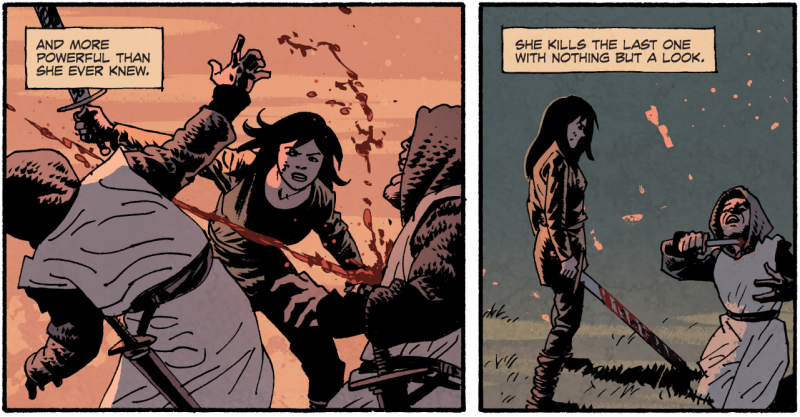
She escapes into the forest and is found by an old man, Ganix, who has no interest in her body and instead allows her to heal and live with him as she pleases. Several years pass until Ganix returns from one of his infrequent trips to a nearby town with the religious order on his heels. They capture him but, Mathilde having hidden, leave without her. She tracks them down where she finds the order sacrificing Ganix and, despite knowing it’s a trap, she attacks, confident in her abilities.
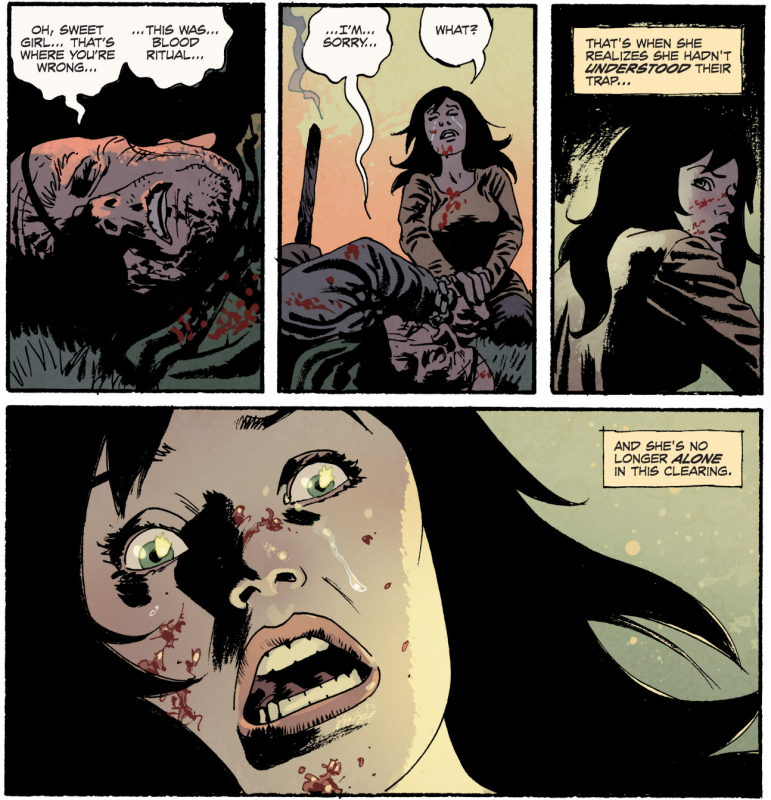
But things are not what they appear and, Mathilde realises things have gone wrong.
FATALE was a damn fine series if you like a bit of detective fiction with horror elements and if you’ve not read it, it’s worth tracking down the collected editions.

Random Retrospective #34 – Young Justice #43

The original run of YOUNG JUSTICE in the late 90s was founded on a definite sense of fun. It featured Superboy, Robin and Impulse as the core team who were very quickly joined by Wonder Girl, Arrowette and the created for the series character Secret, as a bunch of teen superheroes learning the trade with their sort of babysitter/guardian the Red Tornado. The membership of the team changed as time went on, as is the nature of team books, but the sense of fun and good natured anarchy was always there for the most part.

And every now and then, there’d be an issue like this one where something serious raised it’s head.

For background, Traya (Red Tornado’s adopted daughter) and Cissie (who had quit her role as Arrowette) both attend a girls’ boarding school where Traya – despite being incredibly intelligent – isn’t well liked by some of the girls, Phyllis and Ellen in particular.

The issue starts with Ellen’s parents being killed by a suicide bomber in Bialya; they were aid workers and caught up in a random attack. When the news breaks and the girls find out that Traya is Bialyan, they attack her during a gym class because knee jerk reactions are always a good thing, right? When Ellen goes missing that night, Cissie calls in Young Justice to look for her, but the other girls kidnap Traya and Cissie in order to terrorise Traya.

Thankfully Superboy arrives before too much damage is done, and Wonder Girl finds Ellen who had just left to find some headspace and work things through on her own. The damage is done, though, and Traya decides to leave, with Red Tornado arriving to take her home the next morning. The school wants to give Traya something of a send off but, inspired by her teacher’s own experience as a Japanese-American interred as a child in the World War II camps in America, Traya decides to stay, just as Wonder Girl returns with Ellen.

And some of them live happily for a while, I guess.

It’s a mostly nicely handled tale of rejecting bigotry and racism based simply on where someone is from and full marks to the team for doing that in a comic that, as I said, was mostly about fun and adventure. It’s a shame Traya – who is portrayed as intelligent throughout – suddenly loses some of those smarts on that last page (she can’t say the word “expelled”? She doesn’t get the relevance of the hat even though she was the one who knew what was written on the Liberty Bell?) so that Ellen can have her moment of redemption, but other than that I think this works.

Random Retrospective #33 – Preacher #26

The Late lamented Vertigo imprint in the 90s was dominated, I think, by two titles – THE SANDMAN at the start of the decade, and PREACHER at the end of it. Both of them are fantastic series and I don’t mean to compare them with each other; THE SANDMAN has its roots in old and high fantasy which lends itself to a certain type of storytelling, while PREACHER is very definitely rooted in the (then) present, the world of Tarantino, violence and horror. One thing that Garth Ennis has over THE SANDMAN, though, is his ear for dialogue – this issue is mostly narrated by Cassidy, the Irish vampire, recounting his origin story to Jesse, and it’s full of profanity and wonderful turns of phrase and the occasional profundity as well.

The above isn’t the best example of a life view, but it makes sense from Cassidy’s point of view who, by this time, has had a rough old life.

We get to see Cassidy’s first group of friends that he made after landing in New York, though the only one with any real personality is Mick MacCann – the others are little more than a couple of appearances, and a couple of catch phrases, a device that Ennis relies on too heavily in a lot of his other work. There’s ruminations on the Easter Rising of 1916 which was covered in the previous issues, and Cassidy’s not a fan:

It’s Mick MacCann lending Cassidy a copy of Dracula that allows him to realise what he was and move on in the world, and after two decades he knows he’s not getting any older – at least in terms of appearance – while MacCann and the others are, and so decides to tell them that he’s leaving, rather than watch them all get old and die.

Despite his best intentions though, he’s unable to face them and instead stands outside their regular pub and watches them leave.

Cassidy’s relationship issues will play a larger part in the series as it goes on.

It’s a damn fine issue with no real action, just a collection of scenes from Cassidy’s past that help explain who he is and why he feels an attachments to Jesse, which will pay off terribly in later issues. Ennis’s writing is aided and abetted throughout the entire series by the wonderfully clean line work of the late Steve Dillon which still looks good to this day.

If you’re one of the three people who’ve never read the series, it’s heartily recommended.

And I had a letter printed in one issue, as well!

Random Retrospective #32 – Letter 44 #26

I’m pretty sure I took a punt on this title because I’d enjoyed Charles Soule’s run on SWAMP THING and a story about a presidential secret of alien life in the solar system sounded like fun. Looking back, I’m not sure fun was the end result, but it was certainly engaging from the point of view of the writing; for me, the art left something to be desired and I never really clicked with it.

A little under a year left of the run and the crew of the spaceship sent to investigate the alien structure known as the Chandelier have made contact with the aliens and, to give the series its well deserved credit, these aliens aren’t just Star Trek like people with pointy ears of different coloured skin – they are genuinely alien:

Problem is, the whole purpose of the aliens is to destroy not just Earth but the whole solar system. By the time the contact is made, the aliens are working their way to Earth and pause to ignite Jupiter’s core before siphoning off the energy.

Added to all this, back on Earth, and President Blades – ostensibly the focal character on the Earth side of things – has to deal with a message from the aliens laden with Biblical overtones. The aliens have agreed that a tiny number of people will be saved . . . 666 of them. Selecting those people is complicated by Blades’ predecessor who is looking to save his own skin.

Back with the aliens, their difficult ways of communicating prompts one of the crew to take drastic measures to be able to speak with the aliens in a way they can all understand.

LETTER 44 was odd for many reasons, not least the injection of the Biblical stuff into a story which initially was mostly science fiction with some espionage/conspiracy running through it. I think the strangest thing for me, though, was that even though it seemed likely that yes, the world was going to end around the final issue, I was still waiting for something to be pulled out of the bag, some deus ex machina thing that meant the world was to be saved.

Kudos to all involved for creating that feeling and then subverting it.