The most merciful thing in the world, I think, is the inability of the human mind to correlate all its contents. We live on a placid island of ignorance in the midst of black seas of infinity, and it was not meant that we should voyage far. The sciences, each straining in its own direction, have hitherto harmed us little; but some day the piecing together of dissociated knowledge will open up such terrifying vistas of reality, and of our frightful position therein, that we shall either go mad from the revelation or flee from the light into the peace and safety of a new dark age.
“The Call of Cthulhu” by H.P. Lovecraft
Growing up in the late 70s, I already had a fondness for horror stories, and the horror novel boom of the early 80s provided a large amount of my reading material back then, with Stephen King inevitably topping my list of favourite authors. It was probably in Danse Macabre, King’s study of horror in fiction, film, and television, that I first encountered the name of HP Lovecraft (the same book also introduced me to Shirley Jackson, so it wasn’t all bad.)
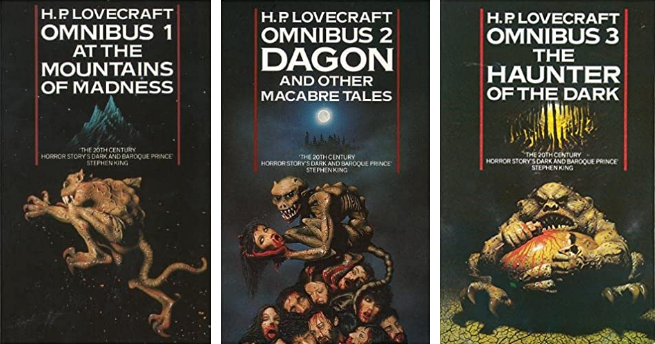
At the time, there were three big paperback collections of Lovecraft’s work in my local bookshop and with the combination of King’s recommendation and the lurid, fantastical, blood-drenched covers, I ended up buying all three.
If you’ve ever read any Lovecraft, you’d be forgiven for being disappointed if you were expecting anything like the scenes depicted on those covers. His writing is overblown and florid, his dialogue stilted, and his characters often one-dimensional. And yet, his stories are often effective – not because of the now cliched ending where the character glimpses some terrible horror and goes insane even while writing his final lines in a journal as the terrible thing approaches . . . but rather because of the sense engendered by that opening paragraph of The Call of Cthulhu, which Lovecraft termed “cosmic indifference.“
There is a feeling running through much of his best work that the terrible beings his villains worship – Cthulhu, Nyarlathotep, and all the other random Scrabble letter deities he invented – simply don’t care about the sacrifices and honorifics that humans heap upon them. Indeed, the most chilling realisation in Lovecraft’s stories is that the universe is utterly indifferent to humanity. Pray to whatever god you like, read whichever holy book you own, once you move beyond the atmosphere of our tiny planet, nothing is listening, and nothing you do matters to the cosmos.
So, why is a comic blog/annotations site babbling on about a horror writer from the 1920s and 30s?
Weirdly, it’s to do with GREEN LANTERN, or at least a specific writer of GREEN LANTERN.
As influential as Lovecraft’s writing has been on modern horror, there’s a real downside to it. Lovecraft was an unrepentant racist and his views pervade much of his work. The Shadow Over Innsmouth, The Horror at Red Hook, and the story I quote at the start of this post, The Call of Cthulhu, all feature terrible peoples who aren’t white and of good New England stock. The villains in so much of his writing aren’t the fantastical aliens worshipped as gods, but the base, depraved, primitive people that Lovecraft’s heroes come up against.
As a young teenager reading those omnibuses shown above, I honestly missed the metaphor and allusions – I read The Shadow Over Innsmouth when I was about 12 or 13 and took it at face value, as a terrifying tale of creatures from the sea breeding with humans, the natives losing their humanity over generations. Growing up and coming back to his work with a more critical eye, you can’t ignore the subtext his unwieldy narrative delivers.
This delivers a sense of cognitive dissonance – on the one hand I enjoy the terrifying, surface level stories, that cosmic indifference that forces you to confront your own tiny, insignificant place in the universe, and the vast alien deities that have no interest in you. Alongside that, the world building of ancient tomes and places shared amongst other authors in their own stories gives a richness and depth to the world Lovecraft’s characters inhabit.
But on the other hand, there’s the guilt felt when enjoying such work – I am not of “the other” that Lovecraft rails against and despises based purely on their origin, so it’s easy for me to gloss over that part of his work. But I shouldn’t, because it can be argued that you can never remove an artist from their work, that to enjoy one is to give acceptance and possibly validation to the other.
Which brings me to GREEN LANTERN.
Last week’s Random Retrospective featured GREEN LANTERN: EMERALD DAWN II, a book written in part by Gerard Jones. At the start of the 90s, Jones almost singlehandedly revitalised Hal Jordan as Green Lantern, with not only the main title but GREEN LANTERN: MOSAIC headed up by John Stewart, but also GUY GARDNER‘s solo title after he was forced out of the Corps, as well as the GREEN LANTERN QUARTERLY anthology title. While he never helmed a cross-company summer event, he devised DC: TRINITY that linked in the GREEN LANTERN, DARKSTARS, and LEGION titles into a crossover, as well as a long run co-writing JUSTICE LEAGUE EUROPE before moving on to JUSTICE LEAGUE AMERICA.
He left comics in the early to mid 90s and turned his hand to non-fiction, mostly about pop-culture – his excellent Men of Tomorrow: Geeks, Gangsters, and the Birth of the Comic Book won an Eisner in 2005.
At the time of writing in 2022, most if not all of his work for DC is unavailable either through their site or Amazon/Comixology as the publisher pulled it following his conviction in 2018 on charges of distributing and possessing images of child sexual abuse.
Unlike Lovecraft, Jones’s work from the late 80s/early 90s won’t have a massive impact on the field; most if not all of it has now been retconned, not specifically because of him and a wish to negate his contributions, but more because that is the nature of comics, the continual churn and introduction of new ideas and origins at the cost of those that came before. There will never be the use of his name as an adjective as people use “Lovecraftian” to describe certain scenes, creatures, or plots.
But there will, for me at least, always be that uncomfortable feeling that if and when I write about Jones’s work with any sense of admiration, or with the acknowledgement that his GREEN LANTERN stories kickstarted that hero’s revitalisation, arguably helping return him to being one of the biggest characters in DC’s canon, it will always be tainted by the fact of Jones’s hideous crimes.
As mentioned above, is it possible to totally remove the artist from their work? A similar situation has arisen recently about JK Rowling and her anti-trans comments. Can Harry Potter fans continue to enjoy those books and films despite the author’s views? Is it okay to celebrate comics written in 1990 by someone who was convicted of child abuse 2018?
I don’t have an easy answer to that. Acknowledging and condemning the facts – Lovecraft’s racism, Jones’s conviction – whenever discussion of their work comes up is, for now at least, the smallest thing I can do. I just didn’t want to leave last week’s post hanging without addressing the elephant in the room.